
I remember the first time I saw Prince on Top of the Pops in the mid ’80s. It was probably the music video for ‘Raspberry Beret’. I was still in primary school, awkward and uncertain about almost everything except how to win at Jacks. He appeared wearing eyeliner and ruffles, radiating a confidence so absolute it felt like watching someone who had invented their own laws of gravity.
“He was doing things that a lot of Black men were afraid to do,” Romeo said in our conversation, “from makeup to heels, to even just being flamboyant.” Forty years later, these words still resonate because the boundaries Prince pushed haven’t disappeared; they’ve just shifted slightly. The revolution remains unfinished.
The Lineage of Sacred Monsters
The French have this wonderful phrase – “monstre sacré” – literally “sacred monster,” used to describe those larger-than-life artistic figures who transgress social norms while commanding respect. Prince was certainly one, and as I sit with Romeo’s reflections about Lil Nas X, I see the lineage connecting them across generations.
I think about the decades separating these two figureheads – Prince emerging in the late ’70s, Lil Nas X in the late 2010s. Forty years between two men who each, in their distinct ways, expanded the possibilities of identity. Forty years during which, despite all the rainbow capitalism and Pride parades and inclusive language, the simple act of a Black man loving another Black man on screen remains rare enough that Romeo can say, “I actually really don’t see Queer Black male relationships on TV.”
Here in the UK it is such a rare sight that the BBC’s Mr Loverman (rightly winning at the 2025 BAFTAs) was… A Thing To See. In 2025 it was a “brave” and “original” story to see.
Spectacle as Strategy
My tea grows cold as I fall into a YouTube rabbit hole – Prince performances from across the decades, Lil Nas X’s “MONTERO” video, interviews where both artists discuss their approach to spectacle. What strikes me is how both understood something fundamental about visibility: sometimes you have to become so spectacularly visible that looking away becomes impossible.
Prince with his purple everything, his symbol replacing his name, his gender-bending fashion that made masculinity itself seem like just another instrument he’d mastered. Lil Nas X with his Satan lap dance, his prison shower choreography, his pink Versace at the Met Gala. Both deployed spectacle not just as entertainment but as strategy – creating imagery so compelling that culture had no choice but to engage.
Romeo describes Prince: “Prince is Black as hell, okay? The attitude, his energy. He’s definitely a force. He’s beautiful. I mean, like stunning, beautiful, beautiful man.”
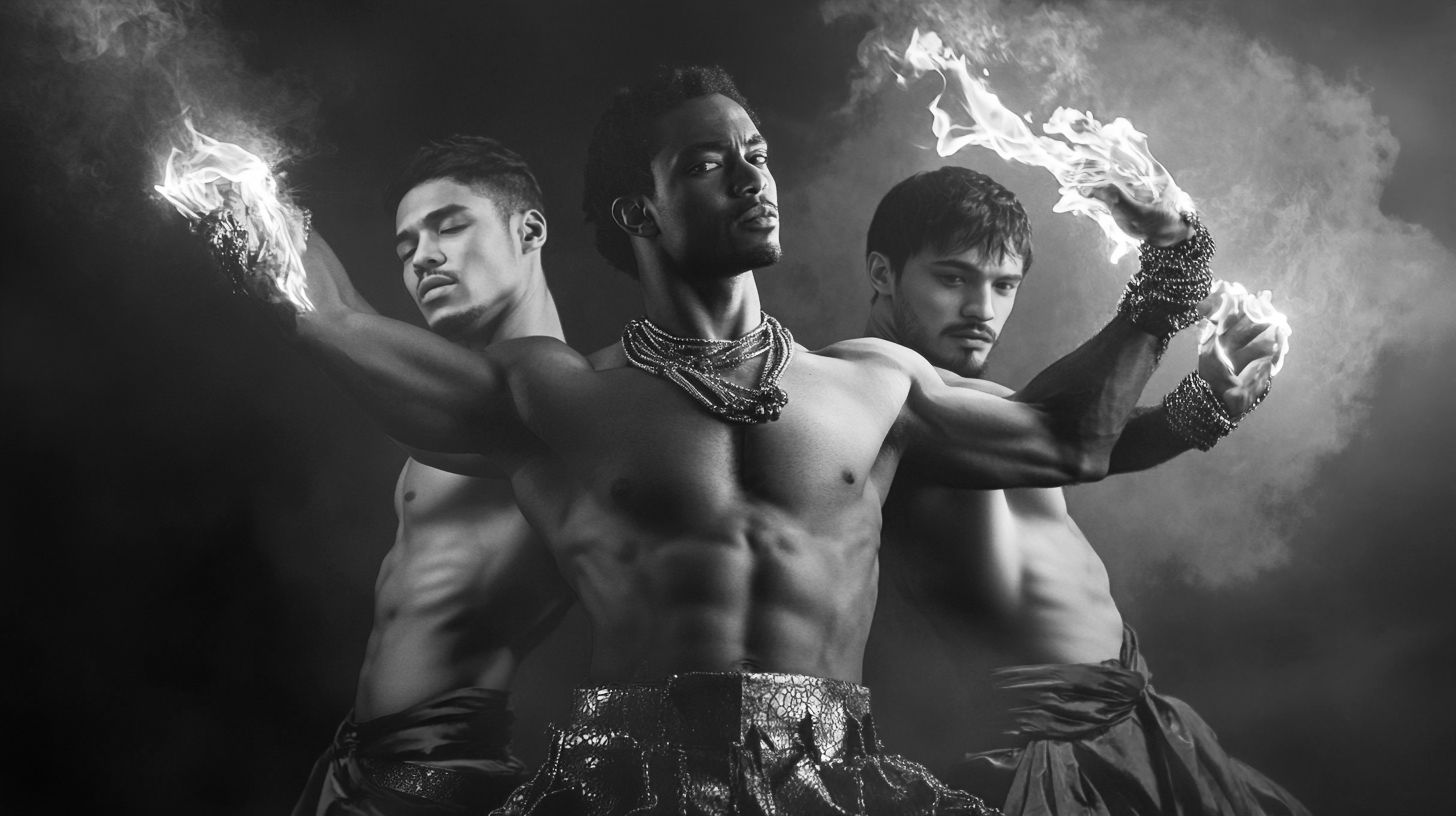
I wonder if this is why Romeo and his twin Cameo chose their distinctive artistic presentation as EHIRE. In a world reluctant to make space for Black Queer artists, perhaps becoming unmistakable is both artistic choice and survival strategy.
The Burden of Representation
Prince had to be a musical genius to be granted the space to experiment with gender. Lil Nas X needed a chart-topping viral hit before he could come out without disappearing. The price of admission remains disproportionately high, the margin for error virtually non-existent.
The cruel mathematics continue: one Black gay artist becomes the permission slip for others, each breakthrough both celebration and reminder of how exceptional one must be to break through. In a more equitable landscape, Lil Nas X would simply be one of many Black Queer artists expressing their truth, not a singular beacon whose success determines whether others might follow. And even then, will society say, “Oh, one’s enough”.
The Shadow of Religion
Prince’s music was deeply spiritual, often explicitly Christian, yet he wrapped these themes in sensuality and ambiguity that made religious authorities deeply uncomfortable. Songs like “I Would Die 4 U” blurred the lines between religious devotion and erotic love, creating space where spirituality and sexuality weren’t oppositional but integrated aspects of human experience.
Lil Nas X’s infamous “MONTERO” video with its religious and satanic imagery did something similar – reclaiming the very symbols used to terrorise Queer kids and transforming them into a spectacular critique of religious homophobia. By literally dancing with the devil, he exposed the cruelty of telling children they’re destined for hell simply for being themselves.
Both artists refused to cede spirituality to institutions that rejected them, instead creating their own sacred languages that encompassed both their sexuality and their spiritual dimensions.
Beyond Idolatry to Inspiration
Romeo speaks of Prince as inspiration rather than idol: “I think all the artists that I’ve listened to, I’ll take them with me.” This carrying forward – absorbing influence without simply imitating – feels crucial. The point isn’t to become Prince or Lil Nas X but to receive the permission they offer to imagine oneself beyond existing constraints.
EHIRE’s music builds upon these influences without being defined by them. Their sound carries echoes that Prince helped shape, but it exists in its own contemporary space. Romeo and his brother Cameo absorb these permissions without becoming derivations.
The Next Sacred Monsters
The sacred monsters of previous generations created space for today’s artists to go further, to break different boundaries, to insist on recognition without having to be once-in-a-generation talents. Prince had to be a virtuoso of nearly every instrument to earn the right to wear lace, heels… what the fuck he wants. Perhaps today’s artists can simply be themselves, their talent acknowledged without requiring superhuman exceptionalism first.
This is perhaps the true legacy of these boundary-breakers – not just their artistic output but the cultural shifts they initiated, the doors they wedged open that others might walk through with less resistance. When Romeo advises fellow artists to “be easy on yourselves,” I hear an invitation to exist without the crushing pressure of having to be exceptional just to be permitted existence.
In the end, the great thing about these sacred monsters isn’t their spectacular talent, but their insistence on wholeness, on refusing fragmentation. Prince wouldn’t separate his spiritual self from his sexual self from his artistic self; Lil Nas X refuses to diminish his Blackness or his Queerness or his religious upbringing to make others comfortable.
This integration – this refusal to be reduced – might be their most profound gift. Not just permission to transgress boundaries, but permission to be whole.
Links
Listen to the episode here
Find the podcast on Apple, Spotify, or wherever you get your podcasts.
Follow us on Instagram, TikTok, and Facebook.
And don’t forget to check out the official podcast playlist on Spotify.
Leave a Reply