
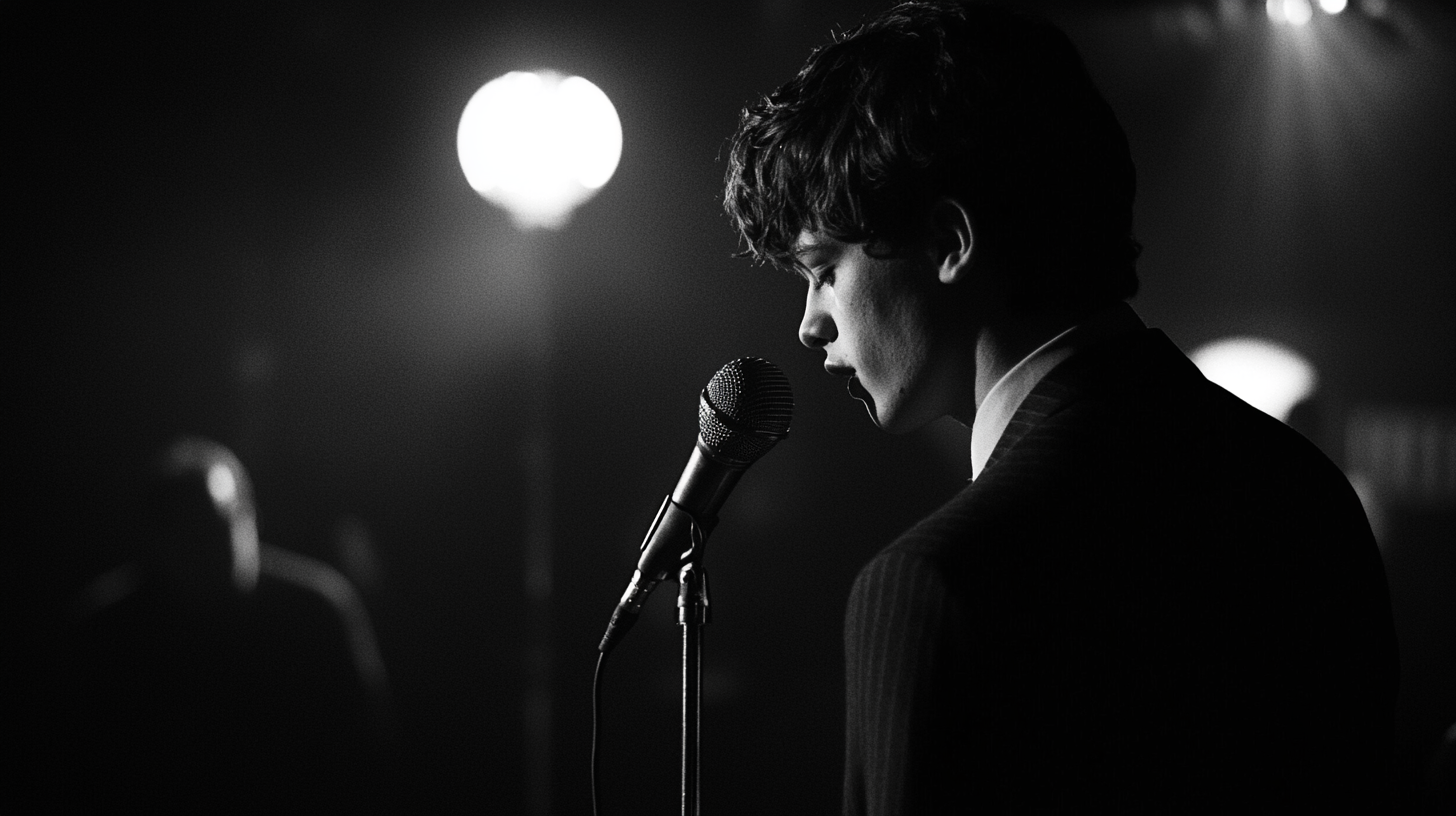
“I’m a very shy guy,” Brazilian musician Erik Lenfair confesses during his interview. Then, almost immediately, he adds something seemingly contradictory: “But I can do that. [I can] play someone else.”
This apparent paradox—the shy person who thrives on stage—runs like a thread through countless queer musicians’ stories. It emerges repeatedly in my interviews with LGBTQ+ artists: the quiet child who becomes the flamboyant performer, the awkward teenager who transforms into a confident vocalist, the introvert who commands thousands with their presence.
Shyness as Queer Inheritance
Erik directly links his shyness to his queer experience: “You just learn that you have something that you have to hide. You have this feeling that people are immediately not going to like you for being the way you are. And that’s a hard feeling to live with. So I think it comes out as shy.”
This connection between queerness and shyness appears frequently in psychological literature. Research suggests that LGBTQ+ youth often develop heightened self-monitoring—constantly evaluating their speech, mannerisms, and interests against perceived norms—which can manifest as social anxiety or shyness.
For many queer people, childhood and adolescence involve deliberate self-dimming. “I would find I would try to make myself as small and as quiet as possible,” notes podcast host Dan Hall, describing his own youth. This instinct toward invisibility represents a survival mechanism—if you can’t be seen, you can’t be targeted.
The developmental impact can be profound. When formative years are spent hiding core aspects of identity, it’s no wonder many queer people describe a persistent sense of guardedness, even after coming out. Erik notes that the “inherent cautiousness” queer people develop “takes a while to get away from you.”
From Concealment to Performance
Given this background, it might seem counterintuitive that so many shy queer people gravitate toward performing arts. Why would someone uncomfortable with visibility seek the spotlight?
“I’m terrible at speaking, but I love singing,” Erik explains. “I love writing. I just go somewhere else.”
This “somewhere else” represents a crucial psychological space. Performance creates a container—a structure with defined boundaries and expectations that allows for expression while maintaining a degree of safety. Unlike everyday social interactions, which can feel dangerously unpredictable, performance has rules. The stage (literal or metaphorical) becomes a designated zone where different rules apply.
For queer people accustomed to careful self-monitoring, performance paradoxically offers relief. Instead of the exhausting task of constantly modulating authentic self-expression, performance involves conscious embodiment of a specific persona. The self-awareness required isn’t diminished—it’s channeled.
The Transformative Power of “Playing Someone Else”
When Erik says he can overcome shyness by “playing someone else,” he’s tapping into a phenomenon recognized by performance theorists and therapists alike: the transformative potential of adopting alternative personas.
Drag performers perhaps exemplify this most explicitly. RuPaul’s famous dictum that “You’re born naked, and the rest is drag” speaks to how all forms of self-presentation involve elements of performance. For shy queer people specifically, consciously constructing a performance persona can provide access to aspects of themselves that feel too vulnerable to express directly.
This isn’t about being inauthentic—quite the opposite. Often, the performance persona represents a more authentic self than the constrained version maintained in everyday life. The “someone else” isn’t truly separate from the performer; it’s an amplified aspect of themselves, given room to breathe in a space that they perceive as safe.
As gender theorist Judith Butler might argue, all gender and sexuality expressions involve elements of performance. The difference for performing artists is that they make this performance explicit and intentional rather than unconscious and habitual.
Beyond Coming Out: Performance as Ongoing Liberation
Coming out represents a critical step for many queer people, but it doesn’t automatically dissolve the protective habits developed during years of concealment. As Erik notes despite being out to his family and making music about gay sexuality, he still carries elements of that childhood caution: “It’s way better nowadays. But it definitely leaves some marks.”
Performance offers a context for continually expanding comfort with visibility. Each time a shy queer person successfully performs, they recalibrate their relationship with being seen—experiencing the vulnerability of visibility without the catastrophic consequences they might have feared.
For Erik, this evolution appears in his music itself. He describes his earlier work as “queer coded, but not explicitly queer” because he wasn’t out to his parents and “didn’t want them to know too much.” His newest song, “Candy Shop,” represents a shift toward explicit expression: “I’m having fun with being gay; talking a lot about dick and cock.”
This progression from coded to explicit content mirrors his increased comfort with visibility. The performance space has become a laboratory for expanding authentic self-expression.
Performance as Expansion, Not Escape
It’s tempting to frame performance as mere escapism—a temporary flight from reality. But for many queer artists, it represents something more profound: an expansion of what reality can contain.
“When I’m making music,” Erik explains, “I love writing. It always allowed me to be more out of the box.” This “out of the box” phrasing reveals how performance doesn’t just offer temporary relief from constraints; it actively challenges those boundaries, gradually widening what feels possible.
Psychologists who work with queer clients often employ techniques drawing on this principle—using role-play, creative expression, and embodiment practices to help people access aspects of themselves that feel too vulnerable for everyday expression. These therapeutic approaches recognise that performance doesn’t just provide temporary escape; it creates lasting change by expanding the range of authentic self-expression.
The Double Life vs. Integration
For earlier generations of queer performers, the stage persona and everyday self often remained rigidly separated—creating what many described as a “double life.” Think of Liberace maintaining public denial of his sexuality while performing with camp flamboyance, or Freddie Mercury’s complex compartmentalisation of his public and private selves. For more on Freddie’s story I suggest watching a film I produced, “Freddie Mercury: The Final Act” (dir James Rogan).
Contemporary queer artists increasingly seek integration rather than compartmentalisation. The performance persona isn’t divorced from everyday life; it’s in conversation with it—sometimes leading, sometimes following, but always connected.
Erik’s experience suggests this more integrated approach. His increased comfort with explicitly queer content in his music parallels greater openness in his personal life. Rather than maintaining separate territories, his artistic expression and personal identity inform each other.
Community Through Performance
For many shy queer people, performance also offers a pathway to community connection that might otherwise feel inaccessible. Shared creative contexts—bands, theatre companies, dance troupes—provide structured social environments where interaction centers around common purpose rather than small talk.
The ritual aspects of performance—rehearsal, preparation, the show itself—create containers for belonging that can feel safer than unstructured socialising. For people who grew up feeling fundamentally out of step with their peers, these artistic communities can become crucial sources of acceptance and understanding.
In Erik’s case, music has connected him not only to the local community in Rio de Janeiro but to international queer networks. Despite creating in a country he describes as having significant issues with LGBTQ+ rights, his music travels beyond those boundaries, participating in global queer cultural conversations.
The Ongoing Journey
Both Erik and podcast host Dan describe shyness not as a fixed trait but as an ongoing negotiation. When asked if he’s managed to shake off his cautious instincts, Erik responds: “I think I still have it. It’s like an ongoing journey to get rid of that.”
This framing of confidence as a journey rather than a destination resonates with many queer experiences. Coming out isn’t a single event but a process repeated across contexts, relationships, and life stages. Similarly, developing comfort with visibility represents ongoing growth rather than a finished achievement.
Performance offers markers along this journey—concrete experiences of being seen and survived that gradually recalibrate one’s relationship with visibility. Each successful performance potentially expands what feels possible in everyday life.
Beyond the Binary
The performing shy person represents just one apparent contradiction among many that queer people often embody. Traditional either/or categorisations—masculine/feminine, public/private, confident/insecure—frequently fail to capture the complexity of queer experience.
Rather than resolving these tensions into neat conclusions, queer performance often deliberately maintains them, exploring the productive possibilities of existing between categories. The shy performer doesn’t overcome shyness to become its opposite; they discover how to hold both shyness and expressiveness simultaneously, moving fluidly between them as context demands.
Performance Beyond the Stage
While this discussion has focused primarily on artistic performance, these dynamics extend into everyday life for many queer people. Code-switching between different social contexts, modulating self-expression based on perceived safety, consciously adopting different personas in different spaces—these represent forms of performance that many queer people navigate daily.
The difference for professional performers is primarily one of intentionality and structure. Rather than these adaptations remaining unconscious or reactive, performers deliberately cultivate and deploy different modes of self-presentation.
Erik’s experience suggests how artistic performance can potentially transform these everyday navigations. As he becomes more comfortable with explicit queerness in his music, that comfort might gradually extend into other contexts, reducing the exhausting vigilance that characterises many queer lives.
The Value of Contradiction
There’s something potently queer about embracing apparent contradiction—about being simultaneously shy and expressive, private and public, cautious and bold. Rather than resolving these tensions or viewing them as problems to overcome, queer wisdom often involves holding them consciously, recognising that complexity doesn’t require resolution.
When Erik mentions being “terrible at speaking” but loving to sing, he’s not describing a problem to fix but a particular way of moving through the world—one shaped by queer experience but not limited by it.
Perhaps this comfort with contradiction represents one of the gifts queer perspectives offer broader culture: the recognition that human experience rarely fits into neat categories, that authentic expression often involves apparently opposed qualities existing simultaneously, that the most interesting art and lives emerge not from resolving tension but from dancing with it.
P.S.
Happy birthday to my dad, Derek Hall, who would have been 78 today. xx
Links
Find the podcast on Apple, Spotify, or wherever you get your podcasts.
Follow us on Instagram, TikTok, and Facebook.
And don’t forget to check out the official podcast playlist on Spotify.
Leave a Reply